
The Mathematics of Beauty > Timeline > 1915 - Sir D'Arcy Wentworth Thompson's On Growth and Form
On the concept of allometry, Thompson wrote:
Thompson pointed out example after example of correlations between biological forms and mechanical phenomena. He showed the similarity in the forms of jellyfish and the forms of drops of liquid falling into viscous fluid, and between the internal supporting structures in the hollow bones of birds and well-known engineering truss designs. His observations of phyllotaxis (numerical relationships between spiral structures in plants) and the Fibonacci sequence has become a textbook staple. Perhaps the most famous part of the work is chapter XVII, "The Comparison of Related Forms," where Thompson explored the degree to which differences in the forms of related animals could be described by means of relatively simple mathematical transformations. - Wikipedia |
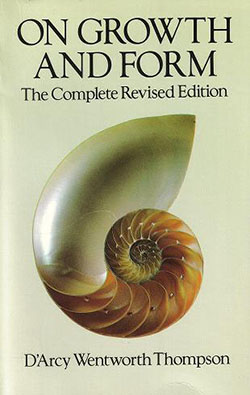 Sir D'Arcy Wentworth Thompson's most famous work, On Growth and Form was written in Dundee, mostly in 1915, though wartime shortages and many last-minute alterations delayed publication until 1917. The central theme of On Growth and Form is that biologists of its author's day overemphasized evolution as the fundamental determinant of the form and structure of living organisms, and underemphasized the roles of physical laws and mechanics. He advocated structuralism as an alternative to survival of the fittest in governing the form of species.