 A British railway engineer, Robert Ballard, saw the pyramids on his way to Australia to become chief engineer of the Australian railways. He watched from a moving train how the relative appearance of the three pyramids on the Giza plateau changed. He concluded that they were used as sighting devices, and wrote a book with the grand title of The Solution of the Pyramid Problem in 1882. - The eBook is for the use of anyone anywhere at no cost and with
almost no restrictions whatsoever. You may copy it, give it away or
re-use it under the terms of the Project Gutenberg License included
with this eBook or online at www.gutenberg.org. A British railway engineer, Robert Ballard, saw the pyramids on his way to Australia to become chief engineer of the Australian railways. He watched from a moving train how the relative appearance of the three pyramids on the Giza plateau changed. He concluded that they were used as sighting devices, and wrote a book with the grand title of The Solution of the Pyramid Problem in 1882. - The eBook is for the use of anyone anywhere at no cost and with
almost no restrictions whatsoever. You may copy it, give it away or
re-use it under the terms of the Project Gutenberg License included
with this eBook or online at www.gutenberg.org.
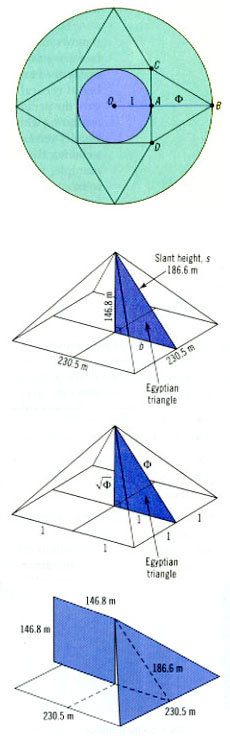
Ballard noted that the cross-section of the Great Pyramid is two of what we have called Egyptian triangles. He constructs what he called a Star Cheops, which, he says, "... is the geometric emblem of extreme and mean ratio and the symbol of the Egyptian Pyramid Cheops."
To draw a star Cheops:
- Draw vertical and horizontal axes.
- Using their intersection as center, draw two circles, radius 1, and radius 1 + .
- Superscribe a square about the smaller circle. This will be the base of the pyramid,
- From the point where an axis cuts the outer circle, draw two lines to the corners of the square. The triangle obtained will be one face of the pyramid.
- Repeat the preceding step for the remaining three faces, getting a four-pointed star. Cut it out.
- Fold each triangular face up from the base forming the pyramid.
- Paul Calter, Squaring the Circle
|
