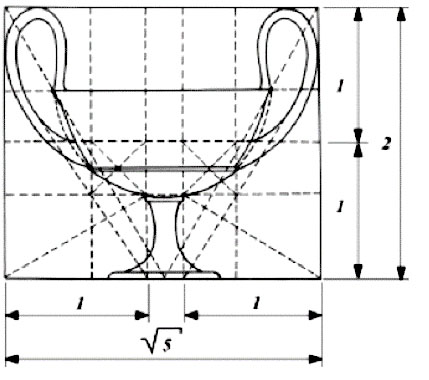
 Convinced that design was not purely instinctive, Jay Hambidge spent much of his life searching for the technical bases of design. He found his answer in Dynamic Symmetry, one of the most provocative and stimulating theories in art history. Hambidge's study of Greek Art convinced him that the secret of beauty of Greek design was in the concious utilization of dynamic symmetry—the law of natural design based upon the symmetry of growth in man and in plants. But Hambidge, who was not only a theoretician, but also a practicing artist, did much more than analyze classical art and its principles of design: he worked out a series of root rectangles which the artist, using the simple mathematics supplied in his book, The Elements of Dynamic Symmetry, can easily follow and apply in his own work. Convinced that design was not purely instinctive, Jay Hambidge spent much of his life searching for the technical bases of design. He found his answer in Dynamic Symmetry, one of the most provocative and stimulating theories in art history. Hambidge's study of Greek Art convinced him that the secret of beauty of Greek design was in the concious utilization of dynamic symmetry—the law of natural design based upon the symmetry of growth in man and in plants. But Hambidge, who was not only a theoretician, but also a practicing artist, did much more than analyze classical art and its principles of design: he worked out a series of root rectangles which the artist, using the simple mathematics supplied in his book, The Elements of Dynamic Symmetry, can easily follow and apply in his own work.
Originally published as a series of lessons in Hambidge's magazine, The Diagonal, this book explains all the basic principles of dynamic symmetry. Part I sets forth the fundamental rectangles with their simple divisions based on the proportioning law found in nature; Part II explains compound rectangles, many of which were taken from or suggested by analysis of objects of Greek art.
- The Elements of Dynamic Symmetry |
