
The Mathematics of Beauty > Timeline > 1800-1900 - Hexagram universally adopted as symbol of Judaism
In the 17th century, the Shield of David as the hexagram began to represent the Jewish community generally, when the Jewish quarter of Vienna was formally distinguished from the rest of the city by a boundary stone having the hexagram on one side and the Christian cross on the other. By the 18th century, the Shield appeared to represent the Jewish people in both secular (politics) and religious (synagogue) contexts. The Star of David can be found on the tombstones of religious Jews in Europe since the 18th century. Following Jewish emancipation after the French revolution, Jewish communities chose the Star of David to represent themselves. Then in the 19th century, it began to signify the Jewish people internationally, when the early Zionist movement adopted it as the symbol of the Jewish people, after the Dreyfus affair in France in the 19th century. - Wikipedia |
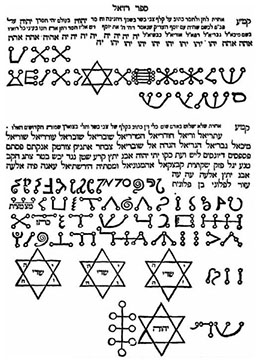 The Star of David, known in Hebrew as the Shield of David or Magen David is a generally recognized symbol of Jewish identity and Judaism. Its shape is that of a hexagram, the compound of two equilateral triangles. The hexagram has been in use as a symbol of Judaism since the 17th century, with precedents in the 14th to 16th centuries in Central Europe, where the Shield of David was partly used in conjunction with the Seal of Solomon (the hexagram) on Jewish flags. Its use probably derives from medieval (11th to 13th century) Jewish protective amulets.