
The Mathematics of Beauty > Timeline > 1792-1873 - U. S. Capitol
A late entry by amateur architect William Thornton was submitted on January 31, 1793, to much praise for its "Grandeur, Simplicity, and Beauty" by Washington, along with praise from Thomas Jefferson. Thornton was inspired by the east front of the Louvre, as well as the Paris Pantheon for the center portion of the design. Thornton's design was officially approved in a letter, dated April 5, 1793, from Washington. In an effort to console Hallet, the commissioners appointed him to review Thornton's plans, develop cost estimates, and serve as superintendent of construction. Hallet proceeded to pick apart and make drastic changes to Thornton's design, which he saw as costly to build and problematic. In July 1793, Jefferson convened a five-member commission, bringing Hallet and Thornton together, along with James Hoban, to address problems with and revise Thornton's plan. Hallet suggested changes to the floor plan, which could be fitted within the exterior design by Thornton. The revised plan was accepted, except that Jefferson and Washington insisted on an open recess in the center of the East front, which was part of Thornton's original plan. The original design by Thornton was later modified by Benjamin Henry Latrobe and then Charles Bulfinch. The current dome and the House and Senate wings were designed by Thomas U. Walter and August Schoenborn, a German immigrant, and were completed under the supervision of Edward Clark. - United States Capitol, Wikipedia
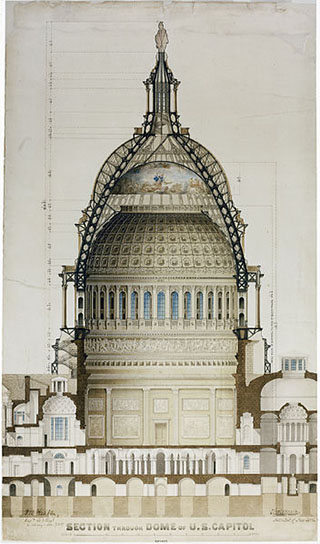
Plans began in May 1854 to build a new cast-iron dome for the United States Capitol, sold on the aesthetics of a new dome, as well as the utility of a fire-proof one.[8] Influenced by the great domes of Europe, Walter paid particular attention to the Pantheon of Paris, St Paul's Cathedral in London, St. Peter's Basilica in Rome and Saint Isaac's Cathedral in Saint Petersburg. William Allen, Historian of the Capitol, described Walter's first design as,
Walter drafted a seven-foot (two-meter) drawing of the aforementioned design and displayed it in his office, where it drew the excited attention of members of Congress in 1854. A year later, on March 3, 1855, President Franklin Pierce signed off on the appropriation of $100,000 to build the dome. Construction began after some practical changes to the original design (such as the reduction of the columns from forty to thirty-six) in September of that year with the removal of the dome raised by Charles Bulfinch. A unique scaffold was built inside the rotunda, designed to keep weight away from the weak center area of the floor, and a crane was set within to run on a steam-powered engine (fueled from the salvaged wood from the old dome). - United States Capitol dome, Wikipedia
In the process of transforming the hut shape from its original pliable materials into more difficult stone construction, the dome had also become associated with celestial and cosmic significance, as evident from decoration such as stars and celestial chariots on the ceilings of domed tombs. This cosmological thinking was not limited to domed ceilings, being part of a symbolic association between any house, tomb, or sanctuary and the universe as a whole, but it popularized the use of the domical shape. |
 The Design: In spring 1792, Thomas Jefferson proposed a design competition to solicit designs for the Capitol and the President's House, and set a four-month deadline. The prize for the competition was $500 and a lot in the federal city. At least ten individuals submitted designs for the Capitol; however the drawings were regarded as crude and amateurish, reflecting the level of architectural skill present in the United States at the time. The most promising of the submissions was by Stephen Hallet, a trained French architect. However, Hallet's designs were overly fancy, with too much French influence, and were deemed too costly.
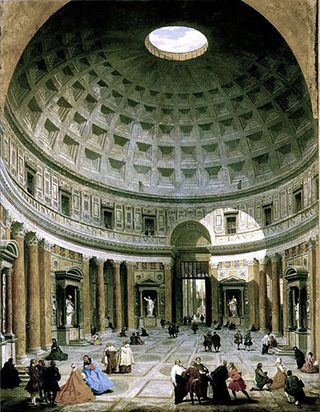
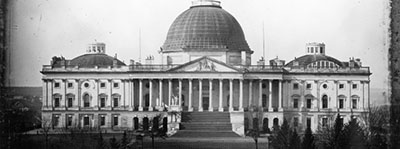
 The Dome: The cast iron dome of the United States Capitol is not the first dome to sit above the building, but the second. The origin of the first dome began with the Capitol design contest sponsored by Secretary of State Thomas Jefferson, at the behest of President George Washington, in 1792. The winner of the contest, Doctor William Thornton, called for a dome in his original design for the building. Most vividly, Thornton drew upon the Roman Pantheon for inspiration with the Neoclassical dome and associated portico. However, Thornton never received the chance to build the dome he envisioned.
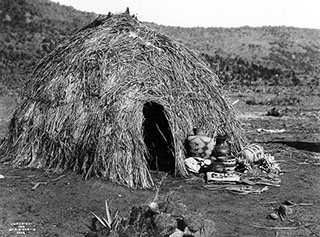 Symbolism of the Dome: According to E. Baldwin Smith, from the late Stone Age the dome-shaped tomb was used as a reproduction of the ancestral, god-given shelter made permanent as a venerated home of the dead. The instinctive desire to do this resulted in widespread domical mortuary traditions across the ancient world, from the stupas of India to the tholos tombs of Iberia. By Hellenistic and Roman times, the domical tholos had become the customary cemetery symbol.
 A distinct symbolism of the heavenly or cosmic tent stemming from the royal audience tents of Achaemenid and Indian rulers was adopted by Roman rulers in imitation of Alexander the Great, becoming the imperial baldachin. This probably began with Nero, whose "Golden House" also made the dome an essential feature of palace architecture.
-
A distinct symbolism of the heavenly or cosmic tent stemming from the royal audience tents of Achaemenid and Indian rulers was adopted by Roman rulers in imitation of Alexander the Great, becoming the imperial baldachin. This probably began with Nero, whose "Golden House" also made the dome an essential feature of palace architecture.
-