The Mathematics of Beauty > Point
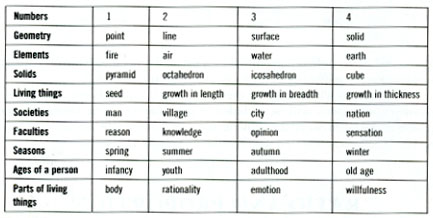
The Sacred TetrakytsThe triangular number ten, or Decad, was especially important to the Pythagoreans and was called the Sacred Tetrakyts. The prefix tetra- means four, and the word Tetraktys means a "set of four things." Ten dots form a neat equilateral triangle with four dots on each side. Ten is important because it is, of course, the number of fingers and the base of the decimal number system. The Pythagoreans also saw significance in ten being the sum of the first four integers: 1 + 2 + 3 + 4 = 10. In Pythagorean number symbolism, the number one represented the point, two the line, three the surface, and four the solid. to the Pythagoreans, the Tetraktys represented the continuity linking the dimensionless point with the solid body. In addition, the Tetraktys, like other triangular numbers, is composed of both odd and even integers (1,2,3, and 4). This is in contrast to the square, which is composed of consecutive odd integers only, and the rectangle, which is composed of consecutive even integers only. Because the Pythagoreans felt that the universe was composed of an interweaving of both odd and even, limited and unlimited, they associated the Tetraktys with the cosmos. The word Tetraktys is attributed to Theon of Smyrna (A.D. 100), a Greek mathematician and astronomer. The Sacred Tetraktys was not the only interesting set of for. Here are ten sets of four given by Theon:
Whenever we have two or more groups containing the same number of things, the notion of connections between the groups naturally arises. Correspondence refers to the idea that any groups defined by the same number are somehow related. For example, Plato associated the four elements with the four solids (fire with the pyramid, earth with the cube, etc.) |
||